

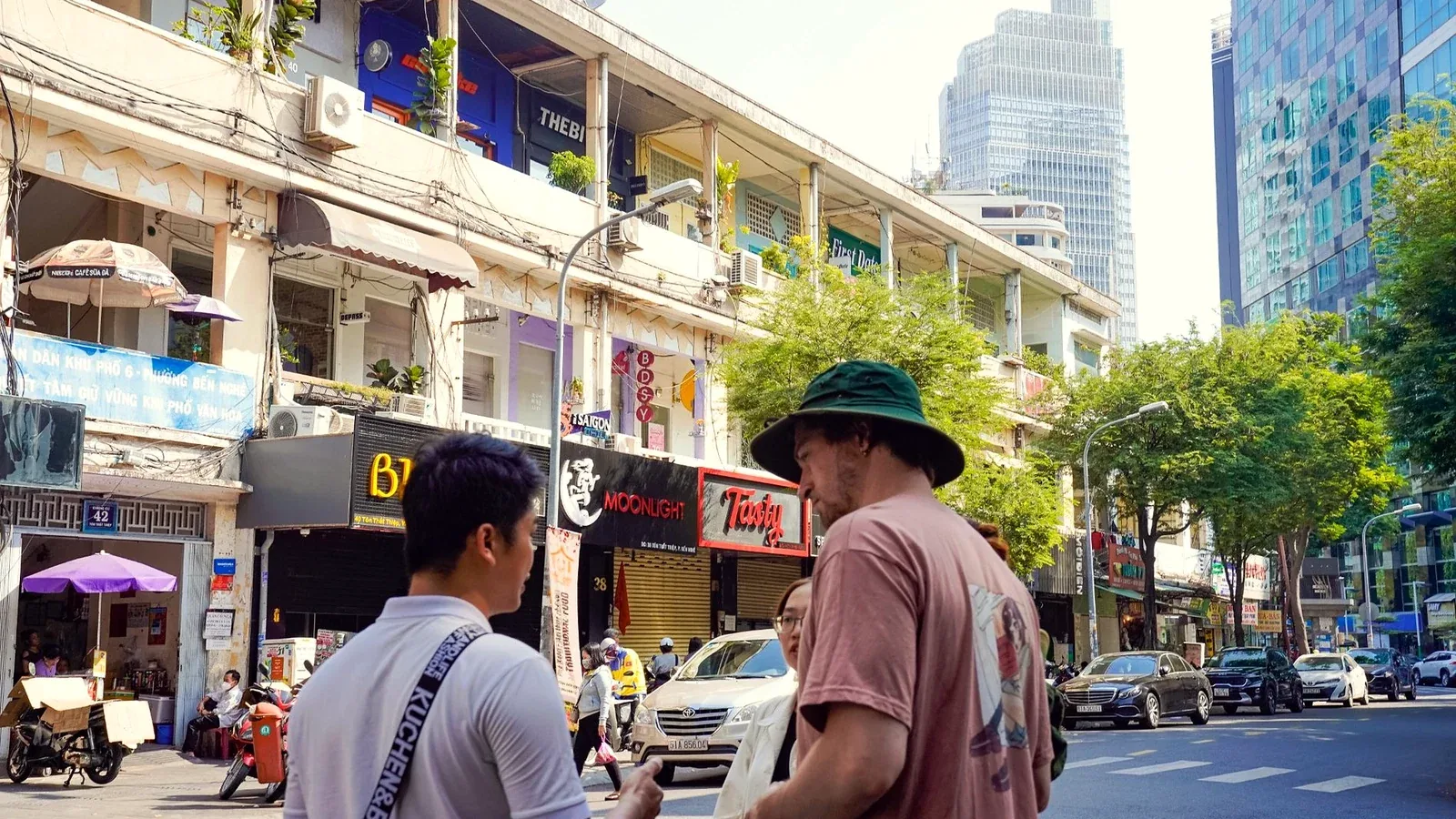
Saigon often explains itself through ordinary street scenes: shade, stools, shopfronts, vendors, small altars and the soft boundary between private life and public space.
The most useful images of Saigon are not always the widest ones. The city often explains itself through hands, thresholds, smoke, plastic stools, parked motorbikes, small altars, improvised shade and the half-second negotiations of the street.
For many visitors, this is what feels most alive about Vietnam: not a single landmark, but the intensity of street life. Food is prepared in front of you. Coffee is poured at the edge of the road. A repair stall opens onto a sidewalk. Someone rests in the shade beside a shopfront. A family altar, a stack of goods, a motorbike, a bowl of noodles and a business sign may all share the same narrow frontage.
The street is not outside daily life
One reason Saigon can feel so visually full is that the boundary between private life and public street is often soft. Domestic routines, commercial work and social life spill outward. The front of a house may also be a shop. The sidewalk may become a waiting room, a dining room, a display shelf, a repair station or a place to talk.
This can look chaotic if you arrive with a strict separation between “inside” and “outside.” But in Saigon, the street is not only a corridor for movement. It is part of the city’s social infrastructure. People use it to earn, rest, watch, serve, buy, pray, park, cook and negotiate space.
Climate is part of the design
There are cultural and historical reasons for this street life, but climate matters too. In a hot, humid city, being outside is not always an escape from comfort; it can be the more breathable option. Shade, airflow and proximity to the street shape how people use space.
That detail is easy for visitors from colder countries to miss. In many cold-weather cities, indoor space carries a stronger sense of privacy, protection and comfort. In Saigon, the street often extends the usable life of a home or shop. The outside is not separate from the inside. It is an operating layer.
Small scenes carry the city
Everyday Saigon is built from scenes that do not need to become attractions. A vendor arranging herbs. A delivery rider balancing too much on a motorbike. A shopkeeper moving goods in and out as the day changes. A coffee table placed where a pedestrian might expect empty pavement. Someone pausing under a tree because the shade has value.
None of this is decorative filler between “real” sites. It is evidence. It shows how the city handles density, heat, work, appetite, ritual and improvisation. It also shows why a walk in Saigon should not only move from landmark to landmark. The route between places is often the place.
What visitors usually miss
Visitors often notice the volume first: the traffic, the signs, the noise, the density. That is understandable. But volume is only the surface. The deeper reading comes from asking what each small arrangement allows people to do.
Why is that stool there? Why does that shopfront open so far into the street? Why does a vendor choose that corner? Why does a family altar face outward? Why does a coffee stop feel social even when no one is performing hospitality for guests?
These are not academic questions when asked on the ground. They are ways to slow down. They turn the city from a spectacle into a system of choices.
This is the attitude behind SaigonWalks: a city route should protect the small scenes rather than rush past them. The point is not to make everyday life exotic. The point is to notice how much of the city is already visible before anyone explains it.