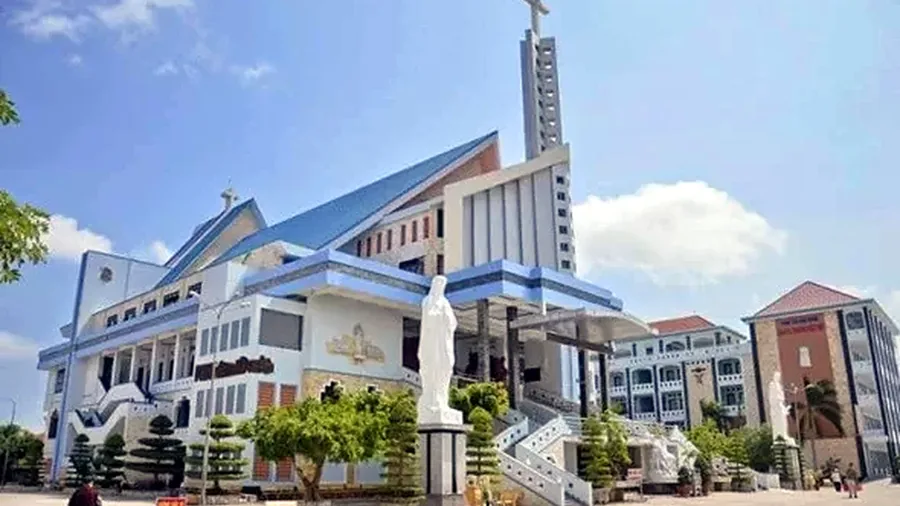


Tac Say is not only a pilgrimage church. It is one of the places where southern Vietnam turns faith, memory and gratitude into a living landscape.
There are places in southern Vietnam that cannot be understood only by reading their official history. You have to watch how people arrive, what they carry, how they stand, what they ask for, and the quiet seriousness with which they leave after saying a prayer. Tac Say is one of those places. On an ordinary day, it may look like another pilgrimage church along the flat roads of the Mekong Delta, surrounded by motorbikes, buses, small shops, food stalls and the practical arrangements of local travel. But for many Vietnamese Catholics, and for many others who would not describe themselves as Catholic at all, this place has long belonged to a different map: a map of gratitude, danger, healing, promises made in distress, and journeys taken after help seemed to arrive.
At the centre of that map is Father Francis Xavier Truong Buu Diep, known in Vietnamese as Phanxicô Xaviê Trương Bửu Diệp and affectionately remembered as Cha Diệp. His name is known far beyond the Catholic communities of Bac Lieu, Ca Mau and Can Tho. People who know little about canon law still know that he was a priest who did not abandon his people. People who may never have studied the history of the Catholic Church in Vietnam still speak of Tac Say as a place where prayers are heard. In the Mekong Delta, holiness often travels through stories before it enters books. A mother tells a neighbour. A bus driver points out where pilgrims stop. A family returns with flowers because something once feared has passed. Long before the Vatican completed its formal process, Father Diep had already become part of the spiritual geography of the south.
That is why the beatification Mass on 2 July 2026 matters far beyond the formal language of the Catholic Church. It does not create devotion from nothing. It receives, examines and publicly names something that has already been alive for decades. For the Church, beatification is a solemn act, a recognition that a person may be publicly venerated in a defined way. For many ordinary people in the Delta, however, Father Diep was already present in a more intimate sense: as a pastor remembered for staying, as a protector invoked in trouble, as a figure whose grave became a place of return. The tension between those two forms of recognition — one official, one popular — is part of what makes Tac Say so compelling.
The story most often told about Father Diep is simple enough to travel from one generation to another. He was a parish priest during a violent and confused period after the Second World War, when southern Vietnam was entering years of conflict, suspicion and fear. In 1946, he was killed after refusing to leave his community. In Catholic memory, the meaning of his death rests not on the violence itself but on the choice that preceded it: the pastor remained with his flock. This is why people do not remember him only as a victim of history. They remember him as someone whose priesthood became most visible at the moment when leaving might have been safer.
That image has unusual power in Vietnam. The country has many official heroes, many historical martyrs, many figures whose lives are tied to dynasties, wars, revolutions and national causes. Father Diep belongs to another kind of memory. He is remembered not because he commanded armies or founded institutions, but because ordinary people believed he stayed close to them when danger came. This is one reason his devotion crosses boundaries. Catholic language speaks of martyrdom, priesthood and beatification. Popular language speaks of linh thiêng, of help received, of a promise fulfilled, of a visit that should be made. The two languages are not the same, but at Tac Say they often stand beside each other.
This is not unusual in southern Vietnam. The Mekong Delta has always been a region of layered belief. A single town may contain a Catholic church, a Cao Dai temple, a Buddhist pagoda, a local shrine and an ancestral altar, all within a short distance of one another. People move through these landscapes with a practical intimacy that outsiders sometimes misunderstand. They may belong clearly to one faith tradition, but still recognise sacredness in neighbouring forms. They may come to Tac Say because they are Catholic, or because their mother once came, or because a relative told them Father Diep helped, or because the Delta has long taught people that spiritual life is not always arranged into neat categories.
Seen this way, the road to Tac Say is not only a Catholic pilgrimage route. It is also a southern Vietnamese route. It passes through a region shaped by water, migration and vulnerability, where communities have repeatedly had to survive political upheaval, poverty, displacement and the uncertainties of rural life. In such a landscape, the figure of a priest who stays with his people acquires a meaning that is both religious and social. He becomes a sign of protection in a place where ordinary people have often had little protection. He becomes a moral memory: when fear comes, do you leave, or do you remain?
The official recognition of Father Diep as Blessed therefore does more than add a Vietnamese name to the calendar of Catholic devotion. It brings a deeply local story into the wider memory of the universal Church. This is not the first time Asia has seen beatifications or canonisations. Japan, Korea, India, the Philippines, China and Vietnam all have long histories of Catholic witness and martyrdom. But the Tac Say event is distinctive because of where it happens and how the devotion has grown. A pilgrimage centre in the Mekong Delta, long shaped by popular devotion and local memory, becomes for one day a place to which the wider Catholic world looks. Rome comes to a story that the Delta has been telling for years.
For visitors who are not Catholic, the meaning of the event may be harder to grasp if it is approached only as a Church ceremony. The better way is to begin with the place itself. Watch the buses arrive. Watch the families who come carrying offerings. Notice how the site functions not only as a church, but as a landscape of memory and gratitude. Listen to the way people speak of Father Diep not with historical distance, but with familiarity. In that familiarity lies the deeper story. Tac Say is not simply where a priest is buried. It is where a community has continued to make sense of loss, fear, protection and faith through the figure of one man.
There is also a danger in stories like this, and it should not be ignored. Popular devotion can easily become a language of requests only: help me pass an exam, heal my sickness, protect my business, solve my difficulty. Every pilgrimage site in the world faces this tension. The question is whether the holy figure becomes only a source of favours, or whether his life continues to ask something of those who come. In the case of Father Diep, the deeper question is not whether prayers at Tac Say “work” in some simple transactional sense. The deeper question is why a man who stayed with the vulnerable in a moment of danger is still loved by people living through very different dangers today.
That is why Father Diep’s beatification is significant even beyond Catholic circles. It shows how official religion, local memory and popular devotion can meet without becoming identical. It reveals a side of Vietnamese Catholicism that is not primarily intellectual, institutional or political, but pastoral, familial and deeply rooted in place. It reminds us that the Mekong Delta is not only a landscape of rivers, rice fields and floating markets, but also a landscape of pilgrimage. And it suggests that some of the strongest religious stories in Vietnam do not begin in grand cathedrals or state ceremonies, but in small communities where people remember who stayed when others could have left.
For SaigonWalks, Tac Say belongs to the wider story of how southern Vietnam remembers. From Saigon to Gia Dinh, from Cho Lon to the Delta, places of worship are rarely only religious sites. They are archives of migration, fear, gratitude and belonging. Father Diep’s story is one of the clearest examples of this. It begins in the Catholic life of the Mekong Delta, but it opens onto something larger: the way ordinary people turn a grave, a church and a memory into a living place of return.