

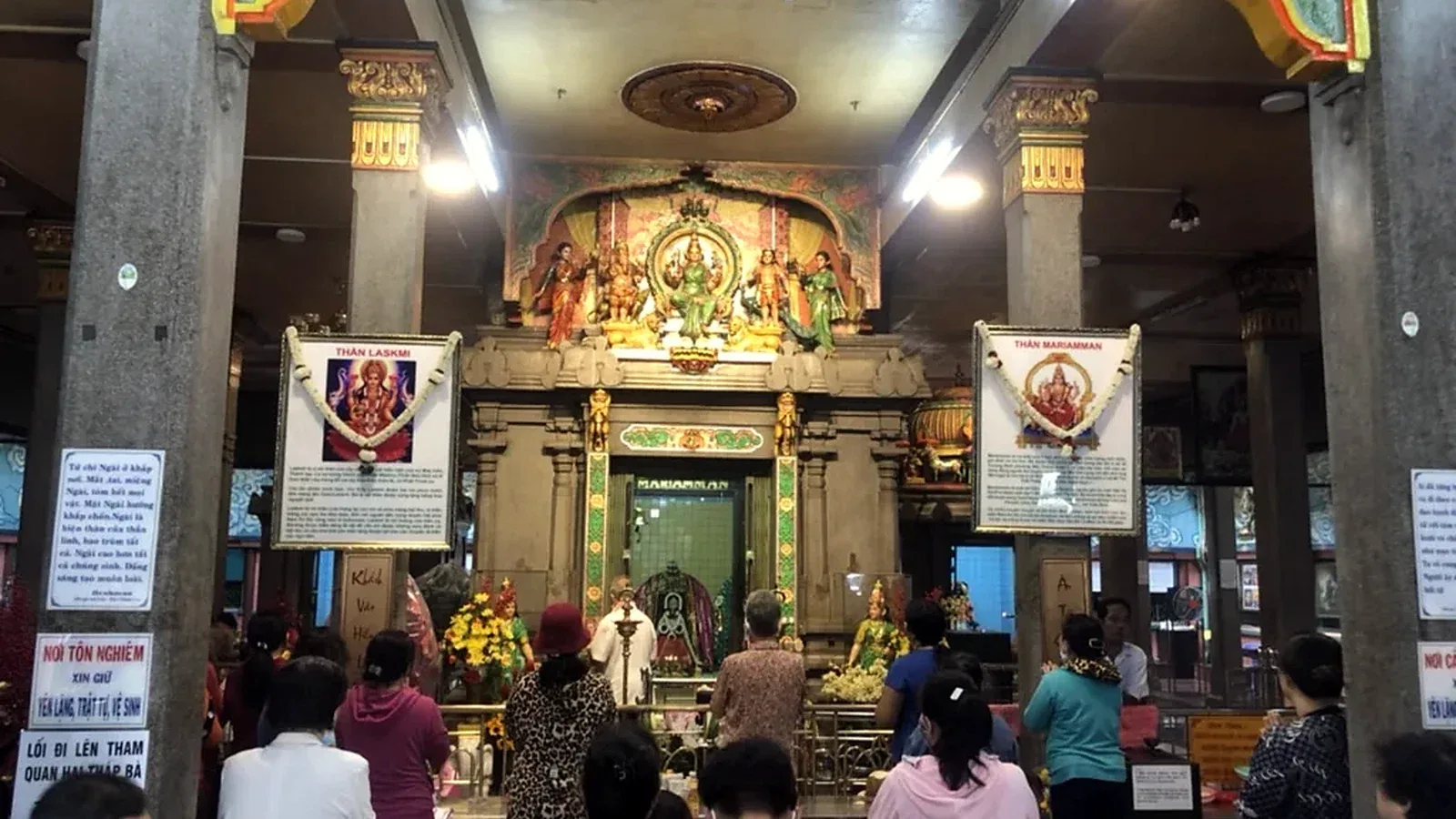
A minority layer of the city, visible in worship, trade routes, food memory and the streets around central Saigon.
Saigon’s Indian presence is small compared with its Chinese, Vietnamese and colonial-era layers, but it is real and visible if you know where to look. The Mariamman Temple at 45 Trương Định is one of the clearest entry points into that history.
The temple is easy to treat as an unexpected sight: a bright Hindu space near Bến Thành, surrounded by traffic, shops and the speed of District 1. But the more useful question is not why it looks unusual. It is how a temple built for a Tamil Hindu community became part of the devotional map of a Vietnamese city.
A temple whose meaning kept moving
Mariamman Temple is dedicated to a goddess widely worshipped in South Indian Tamil traditions, often associated with protection, rain, health and fertility. In Saigon, the temple still carries that Tamil religious language, but it is also visited by many Vietnamese worshippers through their own habits of prayer, offering, touch and hope.
That is why the site should not be reduced to a colourful architectural stop. It is more interesting as a living example of adaptation. A minority religious space can be absorbed into the spiritual life of a wider city without losing its own visual and ritual vocabulary.
More than a small community trace
The Indian story in Saigon also belongs to a wider Tamil commercial world across colonial Southeast Asia. In many port cities, South Indian merchant and financier communities moved through networks of credit, trust, food, worship and kinship. Saigon’s record is thinner than Singapore’s or Burma’s, so it is better to be careful rather than overclaim. But the comparison helps explain why temples, spice shops, vegetarian food and small commercial memories should not be read as isolated fragments.
They point to a city that was already international in the late nineteenth and early twentieth centuries: connected by colonial administration, maritime trade, migrant labour, finance, religion and foodways.
Food memory around the market
The Bến Thành area keeps part of this story in a different form. Curry counters, spice businesses and vegetarian food do not produce a simple “Indian quarter,” but they do show how Indian presence entered Saigon directly through community life and indirectly through wider Southeast Asian food routes.
This is where Saigon becomes more interesting than a checklist of landmarks. The same few streets can hold a Hindu temple, a market, old food businesses, Vietnamese worshippers, office towers and traces of a regional commercial world that has mostly disappeared from public memory.