

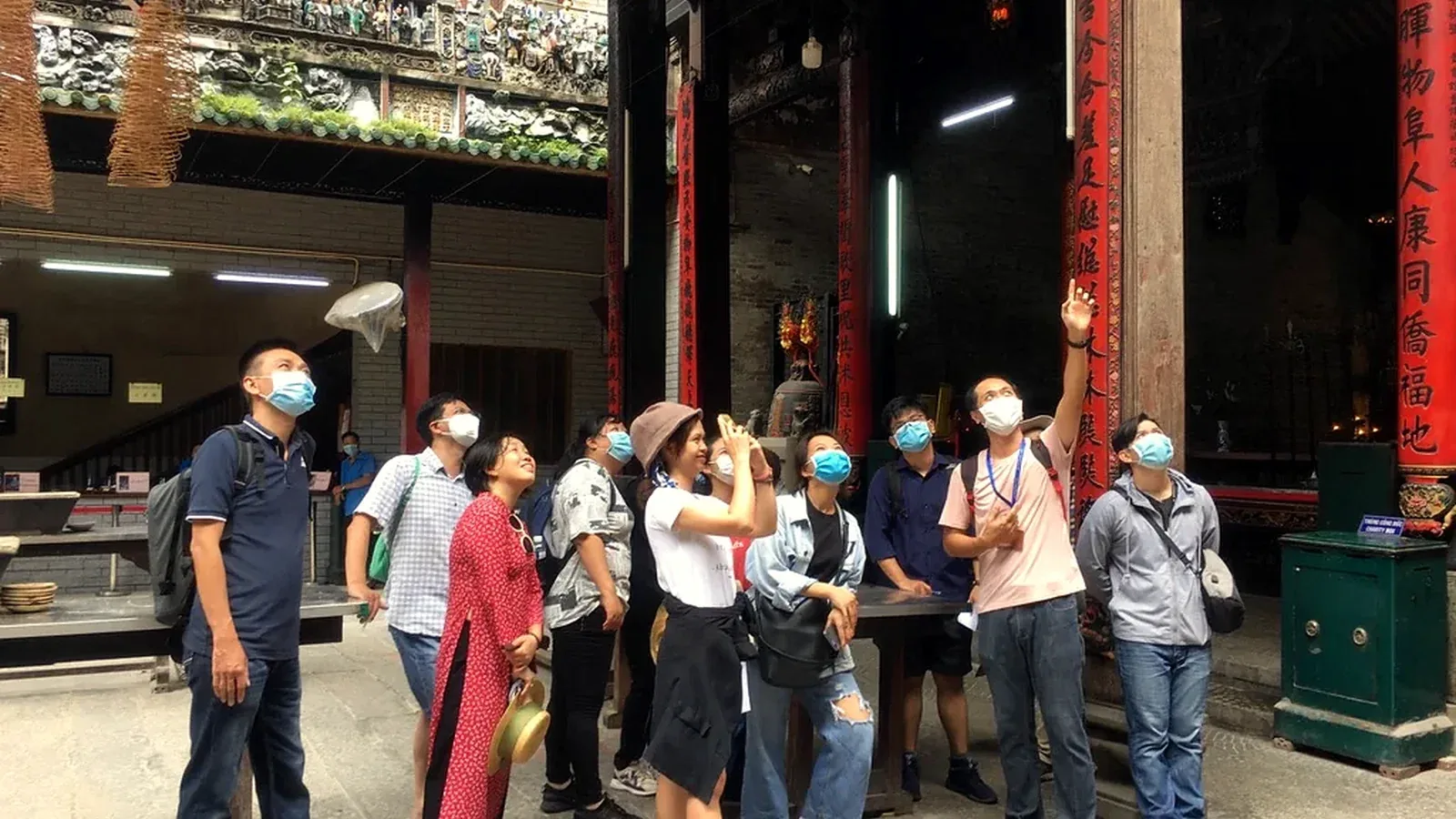
To read Chợ Lớn well, start with the street. Then widen the frame: migration, commerce, temples, association halls and the way migrant institutions settled into Southern Vietnam.
Chợ Lớn is often introduced as Saigon’s Chinatown. The label is useful for orientation, but it can also flatten the district too quickly. It suggests a clear ethnic quarter, a simple visual contrast and a neat boundary between Chinese and Vietnamese life. Chợ Lớn is more complicated than that.
The Chinese presence in Southern Vietnam sits inside a long regional story. Communities moved through maritime routes, political upheavals, trading opportunities and local patronage. Some arrived as merchants, some as migrants escaping conflict, some through colonial-era commercial systems, and some through family and dialect networks that stretched far beyond one city.
Migration became urban structure
In Chợ Lớn, migration did not remain an abstract historical fact. It became visible in institutions. Temples, assembly halls, schools, charitable networks, shops and food businesses were not separate worlds. They helped migrants organize social trust, business reputation, worship, language, mutual support and identity.
This is why a walk through Nghĩa An, Tuệ Thành / Thiên Hậu and Ôn Lăng should not be treated as a sequence of decorative buildings. These places point toward different regional origins and community structures: Teochew, Cantonese, Fujianese and other Chinese-Vietnamese histories that settled into the everyday life of Saigon.
The district is subtle because the cultures are close
Chợ Lớn can be harder to read than Chinatowns in cities where Chinese and local cultures stand apart more sharply. In Vietnam, the cultural overlap is older and more intimate. Visitors may notice the red signs, temple roofs, incense coils and Chinese characters first, but the more important differences may sit in food habits, association names, worship patterns, shop types and the social meaning of certain streets.
The result is a district where the boundary is not always dramatic. Chinese and Vietnamese worlds have shaped one another over time. Some differences remain visible. Others are absorbed into daily routines. A bowl of noodles, a rice roll counter, a temple festival or a shophouse frontage can carry more history than a large monument.
Why the Southeast Asian frame matters
Chợ Lớn is also part of a broader Southeast Asian pattern. Chinese communities across the region often became important in trade, retail networks, finance, food production, transport and urban commerce. But each place adapted differently depending on local politics, colonial systems, social restrictions and relations with surrounding communities.
Seen this way, Chợ Lớn is not only a neighbourhood of Saigon. It is a local expression of a regional history: migration becoming commerce, commerce becoming community, community becoming street life, and street life becoming one of the ways a city remembers itself.
That is why the most useful question is not “Where is Chinatown?” The better question is: what kinds of institutions and habits made this district legible, durable and still alive?