

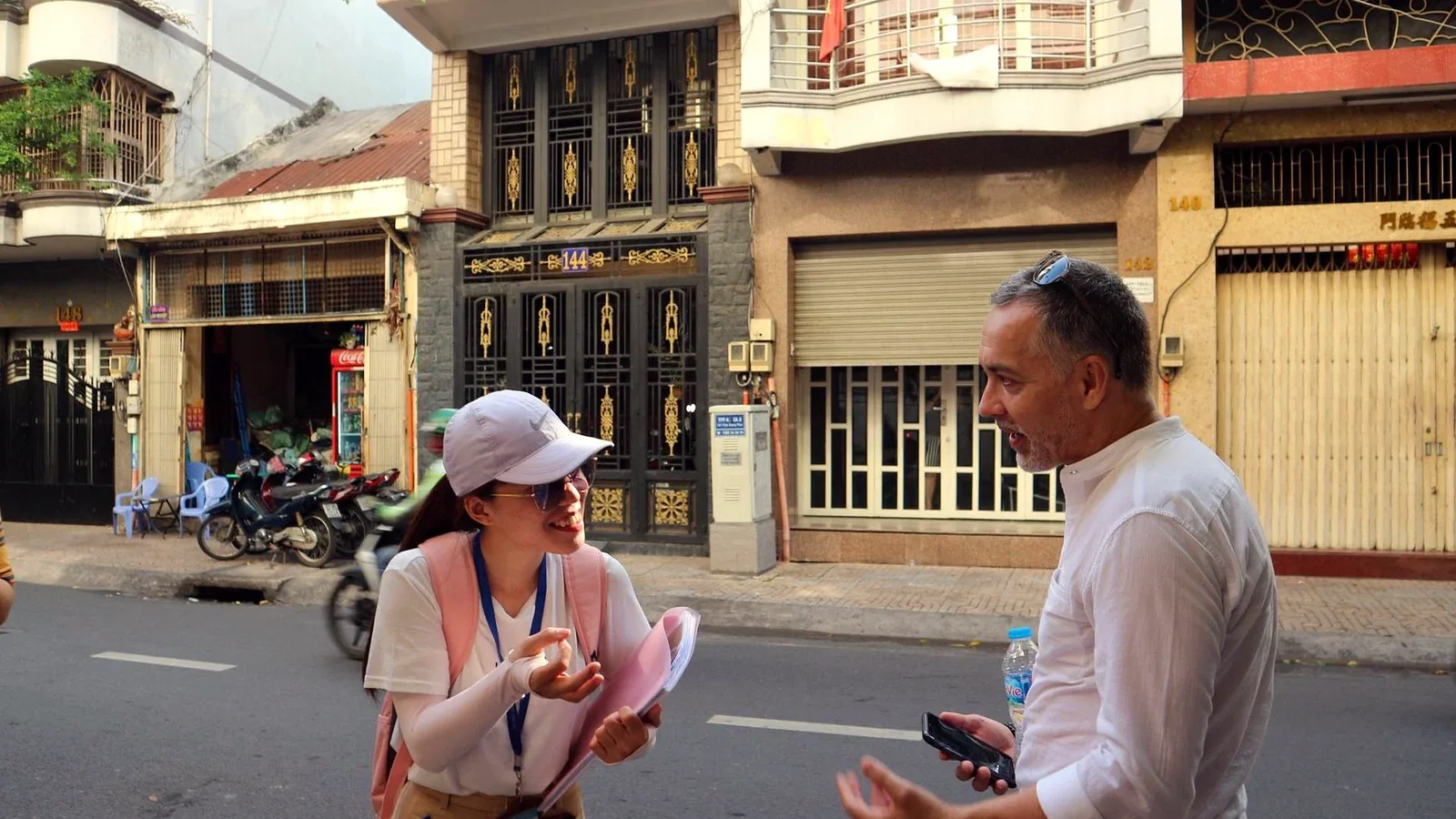
To read Saigon slowly is not to pretend that the city is calm. It is to learn how to stand inside its speed without letting that speed decide everything you see.
On a first morning in Saigon, the city rarely arrives gently. It comes as heat on the skin, as the bright insistence of signs, as motorbikes folding through one another at an intersection, as the clatter of spoons against glass and the rising smell of coffee from a stall that has already been working for hours. Near the old market on Tôn Thất Đạm Street, a bowl of hủ tiếu can appear on a metal table before the day has properly settled. Someone reaches for herbs. Someone calls across the lane. A vendor answers without looking up. The coffee is dark, sweet and cold; the air around it is not.
Nothing about this scene asks to be slowed down. The market does not pause because a visitor has arrived. The traffic does not become orderly in a way that is immediately legible to foreign eyes. The voices do not soften into museum silence. Saigon, at its most ordinary, is not a city that offers itself in clean frames. It gathers, overlaps, spills and continues.
That is often the first misunderstanding. Newcomers tend to meet the city through volume: the density of vehicles, the quickness of movement, the noise of street life, the layers of buildings pressed against one another, the old shopfront beside the polished tower, the food cart beside the bank, the shrine beside the invoice book. From a distance, or from behind a car window, it can look like disorder. It can feel too exposed, too fast, even a little unsafe.
But Saigon is not without rhythm. Its rhythm is simply not always written in the forms visitors expect. The city often works by adjustment rather than interruption, by small negotiations rather than fixed separations. To understand that, it helps to begin with the one act that makes many first-time visitors nervous: crossing the street.
Saigon is not without order. Its order is negotiated in motion.
At a busy crossing in central Saigon, the instinct is to wait for an opening that may never arrive. The flow seems continuous. Motorbikes do not stop in a dramatic gesture of permission. They move, read, correct, pass, and keep moving. The safest way across is not to run and not to freeze. It is to step slowly, steadily, visibly enough that the people moving around you can understand your intention. You become part of the rhythm. The traffic does not surrender to you, but it makes room.
The city asks for something similar. If you try to conquer Saigon quickly, it will remain a blur of heat, traffic and recommendations. If you stand outside it, waiting for a cleaner version to appear, you may keep waiting. But if you move through it at ground level, slowly enough to be read and to read in return, the surface begins to open.
A small market becomes more than a place to buy things. At Tôn Thất Đạm, the old habit of central-city shopping survives in a form that looks almost improvised: stalls pressed close to the street, familiar customers, high-quality ingredients, vendors who know what belongs where because the arrangement has been tested by years of use. It is sometimes called a “rich people’s market,” but it does not behave like a polished retail space. Its value lies partly in that contradiction. Even as the surrounding business district has been cleaned, rebuilt and made vertical, the market keeps a more conservative memory of how people prefer to buy, choose, talk and return.
Food, in Saigon, often carries that kind of memory. A breakfast bowl is not only breakfast. A curry counter in Bến Thành is not only a place to eat. A coffee stall is not only a pause. These small commercial routines hold older relationships between neighbourhoods, vendors, customers, ingredients and migration. They show how the city absorbs difference without always turning it into display. Indian traces, Chinese-Saigon noodles, Southern herbs, colonial-era arcades, Catholic churches, communal houses and sidewalk cafés may sit surprisingly close to one another, not as a planned cultural exhibition but as the ordinary result of a port city that has long lived by arrival, adaptation and trade.
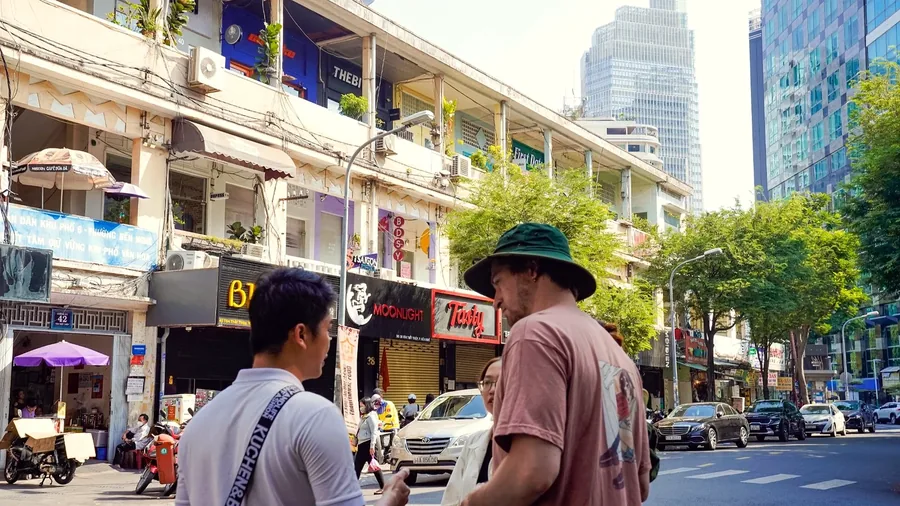
This is why the street matters. In many cities, the street is mainly a corridor between private interiors. In Saigon, the boundary is softer. A home opens into a shop. A shopfront becomes a dining room. A sidewalk becomes a waiting area, a repair counter, a coffee room, a place to sit, a place to watch, a place to pray before work begins. Domestic life, business life and public life do not always stay in separate rooms. They lean into one another.
Climate has something to do with this. In a hot, humid city, the outside is not always the opposite of comfort. Shade has value. Airflow has value. A doorway left open, a stool moved to the edge of the street, a hot drink taken in the middle of a hot morning—these are not picturesque details placed there for visitors. They are small solutions to the conditions of daily life. Saigon’s street life is cultural, but it is also practical. It is shaped by heat, work, appetite, habit and the human need to remain near other people.
To call this “local” is almost too easy. Saigon does not become more real simply because a place is hidden, crowded or free of foreign visitors. A fashionable café can be part of the city. So can a tourist-facing market. So can a temple visited by both worshippers and photographers. The question is not whether something looks untouched. The better question is whether it reveals how people actually use the city, how they make a living, keep a ritual, carry a taste, hold a memory or make a corner bearable.
That kind of attention changes the way Saigon looks. The motorbike is no longer only traffic; it is family transport, delivery system, mobile shop, social instrument, weather strategy. A vendor’s repeated greeting is not merely friendly colour; it is customer memory. A small altar at a storefront is not decoration; it is a quiet negotiation between commerce and belief. The sound of Vietnamese around a market is not background noise; it is part of the texture by which the place organizes itself. Even contradiction becomes useful: walking in a city built for motorbikes, finding stillness beside a loud road, seeing tradition persist inside a rapidly modernizing centre.
Saigon differs from Hanoi, Hội An, Bangkok, Singapore or Hong Kong not because it is simpler than any of them, but because it still sits so visibly between conditions. It is commercial and intimate, ambitious and improvised, outward-looking and deeply habitual. It is modernizing quickly, yet much of its social life remains close to the street. It is Vietnam at its most global-facing, but not in a way that erases the small routines through which people know how to live here.
For travellers, this can be the beginning of affection. Not the easy affection of a city arranged beautifully for arrival, but the slower kind that comes when a place first resists you, then begins to make sense. You learn not to demand quiet before you can observe. You learn not to mistake density for confusion. You learn that a city can be generous without being gentle.
Stories begins from that simple discipline of noticing. The pieces gathered here are not meant to explain Saigon completely. No short article, no walk, no morning in a market could do that. They are invitations to stay longer with a detail: a bowl of noodles, a temple courtyard, an old shophouse, a theatre form, a wharf, a cup of racket coffee, a stretch of street where the city’s private and public lives meet in plain sight.
The city will not slow down for you. But after a while, if you stop asking it to, something changes. You begin to hear pattern inside the noise. You begin to see care inside the improvisation. You begin to understand that the route between places is not empty space. It is often where Saigon is most fully itself.
That is one way to begin reading Saigon: not as a checklist, and not as a spectacle, but as a living surface that rewards patience. The longer you look, the less ordinary the ordinary becomes.