

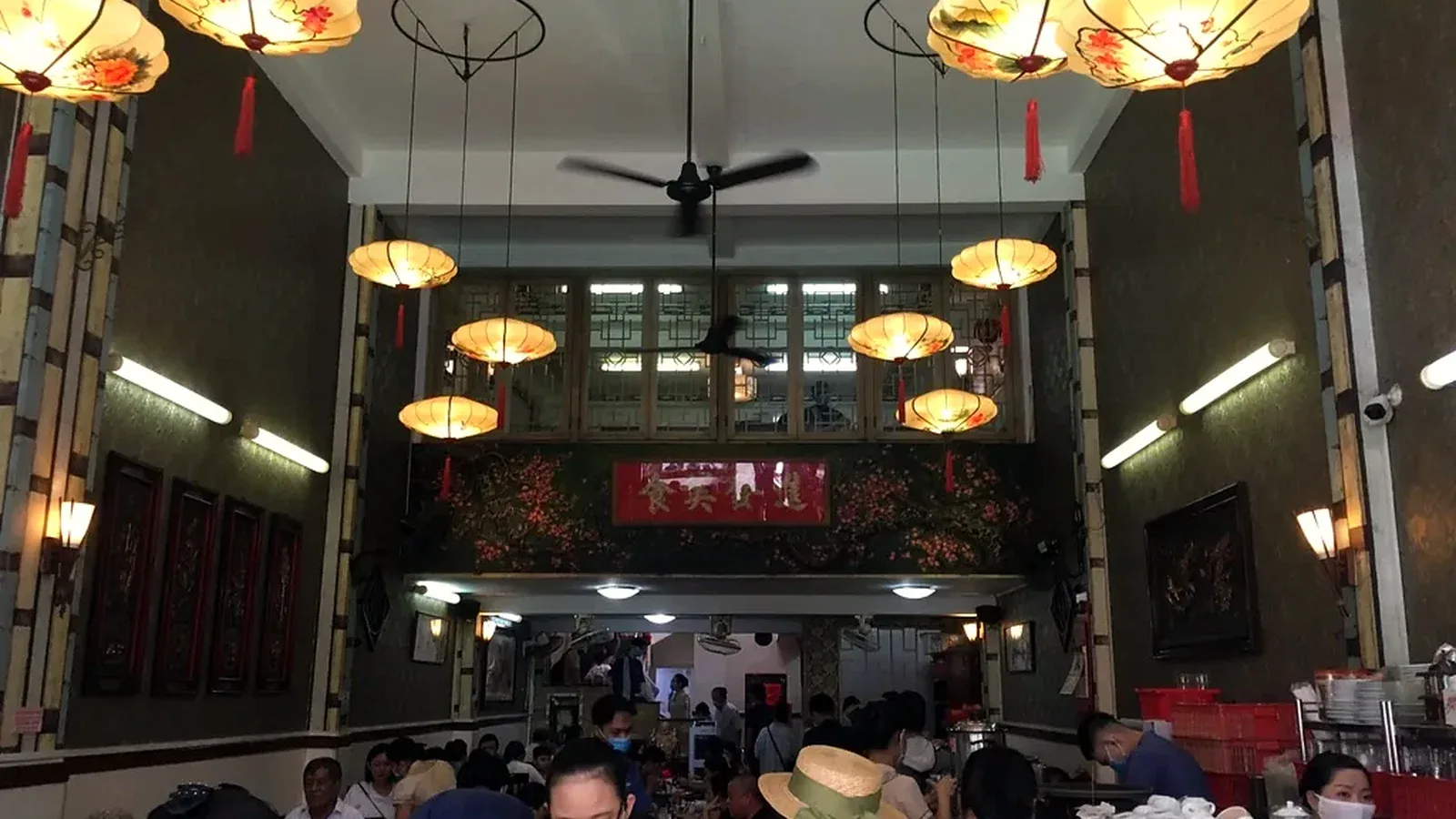
Chợ Lớn is easiest to misread when treated as a simple Chinatown image. Breakfast and coffee slow the district down enough to notice institutions, street life and Chinese-Vietnamese layers together.
Chợ Lớn is too layered to understand by looking for a single “Chinatown” image. Its Chinese-Vietnamese life is visible, but not always in the ways visitors expect. The signs, temples, food, shophouses and street routines may seem familiar at first. The difference sits in the details.
This is not a district where Chinese culture appears as a decorative contrast to the city around it. Chợ Lớn sits inside a Vietnamese urban system with long cultural overlap. That makes it more subtle than many Chinatowns in Western countries, and sometimes more difficult to read than Chinese quarters in places where the boundary between Chinese and local culture is sharper.
Start with what is observable
The best entry point is not a large theory. It is what can be noticed on foot. A temple gate. A language on a sign. An old shophouse frontage. A breakfast counter. A coffee stop where people sit among market movement rather than inside a designed café. A vendor who knows exactly how the morning works.
From those details, the larger layers begin to appear. Chợ Lớn is a commercial district, a religious landscape, a social network, a food district and a memory system at the same time. None of those layers fully explains the others. They overlap.
Institutions, not just monuments
Many visitors see temples and assembly halls as beautiful old buildings. They are that, but they are also institutions. In Chợ Lớn, community halls and temples have long connected worship, dialect-group identity, mutual support, commerce and public reputation.
That is why places such as Nghĩa An, Tuệ Thành / Thiên Hậu and Ôn Lăng matter on a walking route. They are not interchangeable stops. They point toward different community histories, different regional origins and different forms of organization among Chinese migrants in Southern Vietnam.
To read them only as religious sites is too narrow. To read them only as heritage architecture is also too narrow. Their meaning sits in the way belief, association, business and neighbourhood life have historically supported one another.
Street life keeps the district legible
The other way into Chợ Lớn is through the street. This is where the district remains most alive for a visitor who is willing to slow down. Food counters, coffee stalls, old shopfronts and market edges show how the area works in practice, not just in memory.
A stop like Ba Lù is useful for this reason. The coffee matters, but the setting matters just as much. You are not sitting inside a relaxed café environment, separated from the city. You are drinking coffee while the market and the street continue around you: delivery, conversation, buying, waiting, noise, heat and movement.
The same is true of a Cantonese rice roll stop. The food is not only a dish to try. It is a way to enter a morning rhythm. Hospitality here often feels direct rather than staged. The friendliness of the vendor, the quickness of service and the closeness of the street all become part of the experience.
Place the morning inside a wider story
Breakfast makes the district approachable, but it should not make Chợ Lớn feel small. The same streets belong to a broader history of Chinese migration, dialect-group associations and Southeast Asian commerce. The temples and assembly halls give that history an institutional shape; the food counters and coffee stops make it visible in daily rhythm.
For a wider frame, read Chợ Lớn belongs to a wider migration story . For a closer street-level lens, read Old shophouses and the quiet logic of Chợ Lớn .
Why Chợ Lớn is easy to misread
Visitors often arrive expecting a clearer visual separation: Chinese here, Vietnamese there. Chợ Lớn does not work that simply. Chinese and Vietnamese cultural worlds have lived beside and through each other for a long time. Some differences are visible, but many require attention: names, offerings, gods, dialect associations, shop types, architectural details, food habits and the social role of certain streets.
That subtlety is the value of the district. Chợ Lớn asks for close observation rather than instant recognition. It also places Saigon within a larger Southeast Asian story: the movement of Chinese communities, the role of trade, the formation of urban commercial quarters, and the way migrant institutions adapted to local political and social conditions from the early modern period into the present.
On our Chợ Lớn In-Depth Chinatown Heritage Walk walk, breakfast and coffee are not interruptions between temples. They are part of the reading. The district makes the most sense when institutions and street life are seen together.